<?xml version="1.0" encoding="utf-8"?><feed xmlns="http://www.w3.org/2005/Atom" ><generator uri="https://jekyllrb.com/" version="3.10.0">Jekyll</generator><link href="https://ou-cpwo.github.io/chi-sird-2026/feed.xml" rel="self" type="application/atom+xml" /><link href="https://ou-cpwo.github.io/chi-sird-2026/" rel="alternate" type="text/html" /><updated>2026-04-22T13:50:30+00:00</updated><id>https://ou-cpwo.github.io/chi-sird-2026/feed.xml</id><title type="html">Socio-technical Imaginaries for Responsible Design</title><subtitle>A CHI 2026 workshop that explores socio-technical imaginaries for responsible design</subtitle><entry><title type="html">About</title><link href="https://ou-cpwo.github.io/chi-sird-2026/About/" rel="alternate" type="text/html" title="About" /><published>2025-12-17T00:00:00+00:00</published><updated>2025-12-17T14:20:02+00:00</updated><id>https://ou-cpwo.github.io/chi-sird-2026/About</id><content type="html" xml:base="https://ou-cpwo.github.io/chi-sird-2026/About/"><![CDATA[<p>This workshop aims to create a space for critical reflection, collaboration, and imagination around the responsible design of technology, bringing together diverse voices and visions to explore how we can leverage new approaches, technologies, and mechanisms to better understand the problem, challenge harmful norms, support affected communities, and build safer and more inclusive digital futures.</p>

<p>By foregrounding gendered experiences and interdisciplinary perspectives, we aim to generate new points of view, representations, and imaginations by rethinking what responsibility means in the context of gender-based online harms, decoding the complexities and tensions between different understandings of online harm and responses, to
better understand implications for responsible design and practice. We also aim for the workshop to build a community and inspire future events, such as panels and workshops at other SIGCHI venues, research collaborations, and grant applications. This workshop will explore the following questions:</p>

<ol>
  <li>What are the sociotechnical imaginaries of safe online spaces free of gender-based violence?</li>
  <li>What do we mean by responsibility? Who is responsible for what, and to whom?</li>
  <li>What taken-for-granted norms contribute to online harms? How can we change design norms to create responsibility?</li>
  <li>How to deal with tensions between distributing individual and shared responsibilities in managing online harms?</li>
  <li>What does being responsible look like in design and its processes, and organizational arrangements? What are symbols, narratives, and representations of ‘being responsible’?</li>
  <li>How to put responsibility in design? Which methodology works (and in what contexts)?</li>
  <li>What does responsible design for tackling gender-based online harm require in practice?</li>
</ol>

<p>For more information on topics of interest and how to register your interest in participating, please visit:  <a href="https://ou-cpwo.github.io/chi-sird-2026/cfp/">https://ou-cpwo.github.io/chi-sird-2026/cfp/</a></p>]]></content><author><name></name></author><summary type="html"><![CDATA[This workshop aims to create a space for critical reflection, collaboration, and imagination around the responsible design of technology, bringing together diverse voices and visions to explore how we can leverage new approaches, technologies, and mechanisms to better understand the problem, challenge harmful norms, support affected communities, and build safer and more inclusive digital futures.]]></summary></entry><entry><title type="html">Position Papers</title><link href="https://ou-cpwo.github.io/chi-sird-2026/CHI-submission/" rel="alternate" type="text/html" title="Position Papers" /><published>2025-12-17T00:00:00+00:00</published><updated>2025-12-17T14:21:02+00:00</updated><id>https://ou-cpwo.github.io/chi-sird-2026/CHI-submission</id><content type="html" xml:base="https://ou-cpwo.github.io/chi-sird-2026/CHI-submission/"><![CDATA[<p>We are pleased to share the accepted position papers of the workshop participants below:</p>
<ul>
  <li><strong>Forattini, F. M.</strong>: <a href="/chi-sird-2026/assets/documents/CHI-SIRD-06.pdf">Responsible Design Through Care: A Relational Framework for Gendered Harm</a></li>
  <li><strong>Kondo, A.</strong>: <a href="/chi-sird-2026/assets/documents/CHI-SIRD-07.pdf">Augmented Lookism and Responsible Design</a></li>
  <li><strong>Mohammad Faud, F. M. b., Mohd Nor, M. W., Mohd Nor, M. S., Adnan, Z. H., b.</strong>: <a href="/chi-sird-2026/assets/documents/CHI-SIRD-09.pdf">Gendered Hate Speech and the Silencing of Women on Social Media: Perspective from Malaysia</a></li>
  <li><strong>Naji, A., YekkehbashHeidari, S.</strong>: <a href="/chi-sird-2026/assets/documents/CHI-SIRD-10.pdf">Sociotechnical Imaginaries of Responsible Design: an AI Training Intervention for Gender-based Online Harm</a></li>
  <li><strong>Zhang, Z.</strong>: <a href="/chi-sird-2026/assets/documents/CHI-SIRD-11.pdf">A Hierarchy of Responsibility for Harm Mitigation in Design of Video Games</a></li>
  <li><strong>Ahmed, N.</strong>: <a href="/chi-sird-2026/assets/documents/CHI-SIRD-12.pdf">Reimagining Social Media as Sociotechnical Infrastructure for Collective Responsibility in Addressing Gender-Based Violence</a></li>
  <li><strong>Twomey, J.</strong>: <a href="/chi-sird-2026/assets/documents/CHI-SIRD-13.pdf">Designing Responsibly To Stop Deepfake Abuse Perpetration</a></li>
  <li><strong>De Haro i Pérez, R., Valente, M., Jurasz, O.</strong>: <a href="/chi-sird-2026/assets/documents/CHI-SIRD-14.pdf">Safety by Design: Closing the Regulation-Design Gap</a></li>
  <li><strong>Morais, M. C., Santuber, J., Schülter, J., Lvov, N.,</strong>: <a href="/chi-sird-2026/assets/documents/CHI-SIRD-15.pdf">FA(I)R: Feeling all Rights in Digital World: Participatory approaches to address harmful behavior in digital environments</a></li>
  <li><strong>Rapps, B.</strong>: <a href="/chi-sird-2026/assets/documents/CHI-SIRD-16.pdf">Sociotechnical Imaginaries for Technical Design Workshop</a></li>
  <li><strong>Fitzsimmons, A. Z., Fasiang, K., Gerber, E. M., Long, D.</strong>: <a href="/chi-sird-2026/assets/documents/CHI-SIRD-17.pdf">Towards Increasing Adolescents’ Awareness and Understanding of AI Bias</a></li>
  <li><strong>Barkallah, M., Zytko, D.</strong>: <a href="/chi-sird-2026/assets/documents/CHI-SIRD-18.pdf">Affirmative Consent and Gendered Harm in VR/AR Dating</a></li>
  <li><strong>Kim, H.</strong>: <a href="/chi-sird-2026/assets/documents/CHI-SIRD-19.pdf">Anticipating and Responding to Emerging Forms of Technology-facilitated Gender-Based Violence</a></li>
  <li><strong>Farzand, H., Huan, R., Ramokapane, K. M.</strong>: <a href="/chi-sird-2026/assets/documents/CHI-SIRD-20.pdf">Towards A Sociotechnical Methodology for Responsible Research on Violence Against Women and Girls</a></li>
  <li><strong>Turk, K. I., Talas, A.</strong>: <a href="/chi-sird-2026/assets/documents/CHI-SIRD-21.pdf">Prevention of Interpersonal HARMS Through Threat Modelling</a></li>
  <li><strong>Luther, A. R.</strong>: <a href="/chi-sird-2026/assets/documents/CHI-SIRD-22.pdf">Envisioning Responsible Personal Moderation for Gender-Based Online Harm</a></li>
</ul>

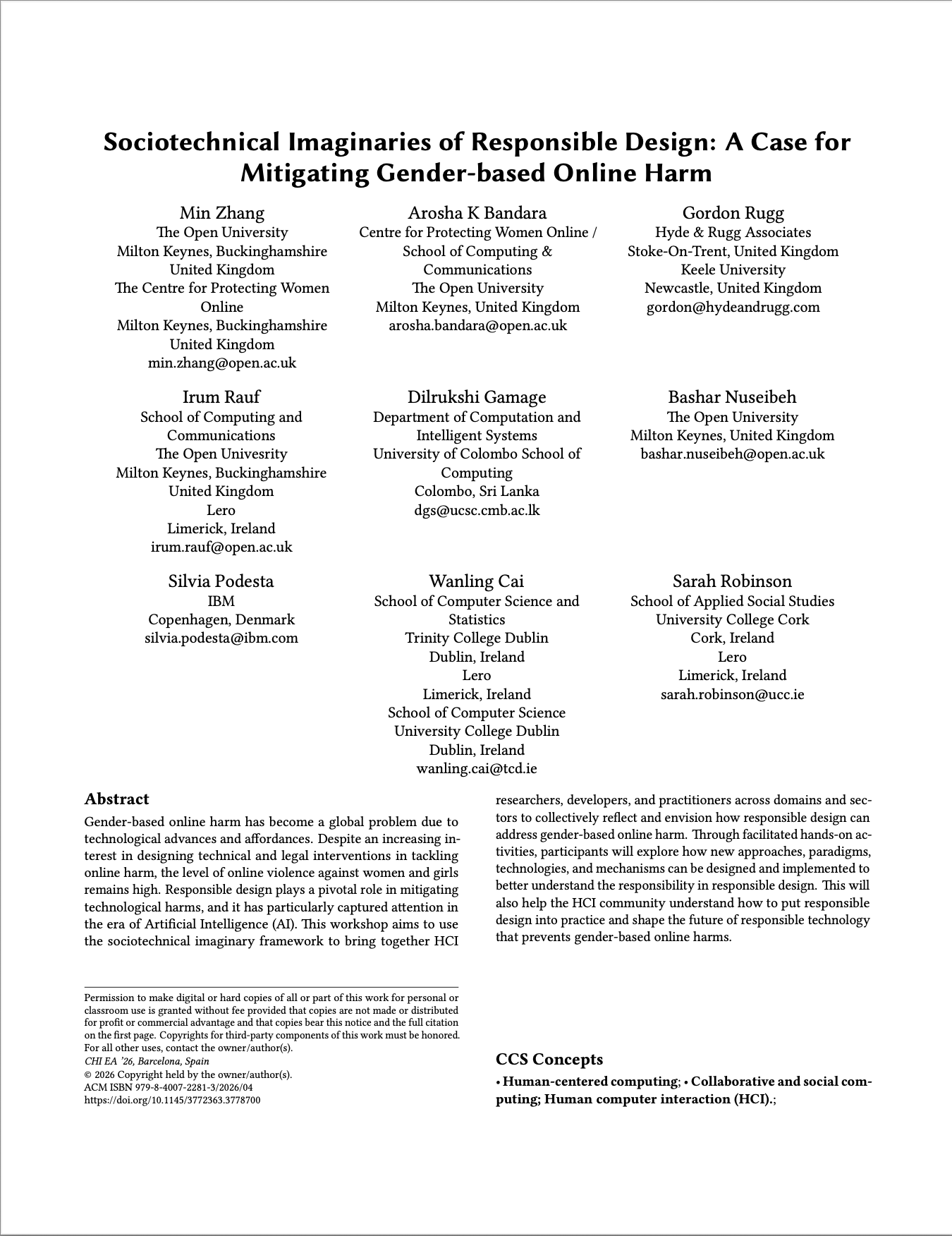
<p><br />You can read the full paper where we described our workshop proposal by clicking on the link below:</p>

<figure>
	<a href="/chi-sird-2026/assets/documents/chi26g-sird-paper.pdf"><img src="/chi-sird-2026/assets/images/chi26-sird-paper.png" /></a>
	<figcaption><a href="/chi-sird-2026/assets/documents/chi26g-sird-paper.pdf" title="CHI 2026 Workshop Proposal">CHI 2026 Workshop Proposal</a>.</figcaption>
</figure>

<p>This work is supported by the <a href="https://cpwo.open.ac.uk">Centre for Protecting Women Online</a>, at The Open University, UK.</p>

<figure>
	<a href="https://cpwo.open.ac.uk"><img src="/chi-sird-2026/assets/images/cpwo_logo.png" /></a>
</figure>]]></content><author><name></name></author><summary type="html"><![CDATA[We are pleased to share the accepted position papers of the workshop participants below: Forattini, F. M.: Responsible Design Through Care: A Relational Framework for Gendered Harm Kondo, A.: Augmented Lookism and Responsible Design Mohammad Faud, F. M. b., Mohd Nor, M. W., Mohd Nor, M. S., Adnan, Z. H., b.: Gendered Hate Speech and the Silencing of Women on Social Media: Perspective from Malaysia Naji, A., YekkehbashHeidari, S.: Sociotechnical Imaginaries of Responsible Design: an AI Training Intervention for Gender-based Online Harm Zhang, Z.: A Hierarchy of Responsibility for Harm Mitigation in Design of Video Games Ahmed, N.: Reimagining Social Media as Sociotechnical Infrastructure for Collective Responsibility in Addressing Gender-Based Violence Twomey, J.: Designing Responsibly To Stop Deepfake Abuse Perpetration De Haro i Pérez, R., Valente, M., Jurasz, O.: Safety by Design: Closing the Regulation-Design Gap Morais, M. C., Santuber, J., Schülter, J., Lvov, N.,: FA(I)R: Feeling all Rights in Digital World: Participatory approaches to address harmful behavior in digital environments Rapps, B.: Sociotechnical Imaginaries for Technical Design Workshop Fitzsimmons, A. Z., Fasiang, K., Gerber, E. M., Long, D.: Towards Increasing Adolescents’ Awareness and Understanding of AI Bias Barkallah, M., Zytko, D.: Affirmative Consent and Gendered Harm in VR/AR Dating Kim, H.: Anticipating and Responding to Emerging Forms of Technology-facilitated Gender-Based Violence Farzand, H., Huan, R., Ramokapane, K. M.: Towards A Sociotechnical Methodology for Responsible Research on Violence Against Women and Girls Turk, K. I., Talas, A.: Prevention of Interpersonal HARMS Through Threat Modelling Luther, A. R.: Envisioning Responsible Personal Moderation for Gender-Based Online Harm]]></summary></entry></feed>